
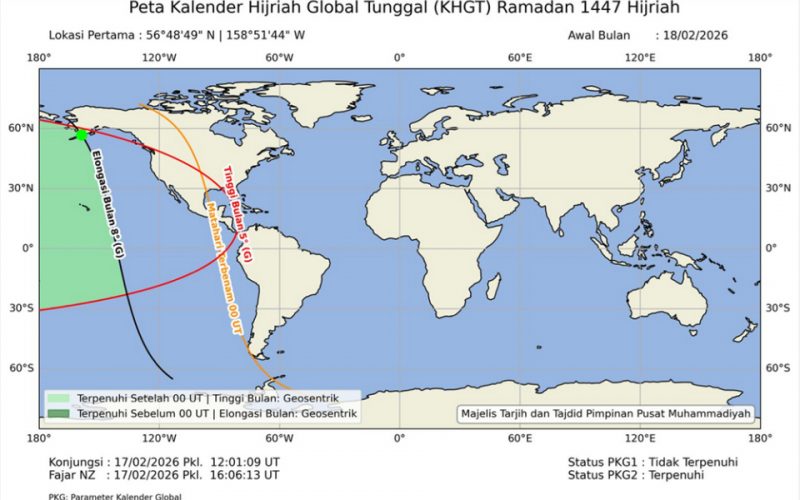
The difference in determining the start of Ramadan and Eid al-Fitr is a phenomenon we often encounter. For some of us, this may create a sense of unease or a longing for complete togetherness. Amidst this yearning for unity, an interesting initiative has emerged from our brothers and sisters in Muhammadiyah, known as the Unified Global Hijri Calendar (KHGT).
This concept offers the principle of “one day, one date” for the entire world. Its goal is noble: to unite the global Muslim community in a single rhythm of worship. It sounds highly visionary and full of the spirit of unity, doesn’t it?
However, every new idea certainly opens space for discussion. Let us try to analyze these dynamics with a clear mind, particularly regarding the planned implementation of KHGT for the upcoming Ramadan 1447 H (2026 CE).
Case Study: The Start of Ramadan 1447 H
Ramadan in 2026 will be a historic moment for the implementation of KHGT. Interestingly, the potential difference is no longer merely about methods (Hisab vs. Rukyat) or criteria regarding the crescent’s height, but rather a difference in paradigm between the “Global Hilal” and the “Local Hilal.”
Based on KHGT calculations, the condition for the new month is met on February 17, 2026, due to a conjunction (ijtimak) occurring in the region around New Zealand at 19:01 WIB (Western Indonesian Time). Although in Indonesia the conjunction has not yet occurred and the sun has not yet set, KHGT establishes that 1 Ramadan 1447 H falls on Wednesday, February 18, 2026, for the entire world, including us here at home.
Here lies the point of discussion. Simply put, brothers and sisters following KHGT might already perform Tarawih prayers on the evening of February 17, even though astronomically, the moon’s position in the Indonesian sky has not yet met the conjunction criteria.
Viewed through the lens of rukyat (local observation), this presents a logical challenge. An analogy might help: We know the sun will surely rise tomorrow morning at 6 AM. Does that mean we can pray Fajr (Subuh) at midnight simply because we are certain “the sun will rise later”? Most of us would agree to wait for the dawn to actually break. Ideally, like the dawn, the hilal (crescent moon) should be “present” locally before we commence our worship.
The Hilal: A Natural Phenomenon or an Administrative Agreement?
It is important to understand that astronomically, the hilal is a local optical phenomenon. The visibility of the crescent moon depends heavily on where we stand on this earth. Prof. Thomas Djamaluddin, one of our senior astronomers, often reminds us that enforcing a single date for the whole world often requires “compromising” with the physical reality of the universe.
Furthermore, this effort toward global calendar unification is not unique to Muhammadiyah. Other global institutions, such as Diyanet (Turkey), also have their own global calendars. Interestingly, for Ramadan 1447 H, Diyanet sets the start of fasting on February 19, 2026, differing by one day from KHGT. This demonstrates that even within efforts for global unification, diversity in the results of ijtihad (independent reasoning) remains.
Respecting Scholarly Tradition and Fiqh
In the treasury of Islamic jurisprudence (fiqh), we recognize the concept of Matla’ (zones of sighting applicability). The majority of scholars, including those in the Shafi’i school, acknowledge the existence of differences in the rising times of celestial bodies between regions (Ikhtilaful Mathali’).
This concept of local Matla’ has strong historical backing dating back to the time of the Prophet’s Companions. A popular narration recounts the dialogue between Kuraib and Ibn Abbas (r.a.), where Ibn Abbas in Medina did not follow the sighting results of Muawiyah in Sham (Syria) due to the difference in location, affirming that this was what the Prophet (SAW) taught.
KHGT offers a new approach by considering the entire earth as a single matla’ unit. This is a bold ijtihad, yet on the other hand, it shifts the principle of illat (the legal cause) of worship—which was originally based on the sighting of the moon (or the possibility thereof)—to merely fulfilling global numerical criteria.
Unity: Uniformity or Maturity?
Often, the narrative built is for the sake of “Unity of the Ummah.” However, let us reflect on the true meaning of unity. Since the early history of Islam, the community has been accustomed to differences in worship times due to geography. Prayer times in Jakarta are not the same as in Cairo or London, and this has never been considered a source of division.
True unity may not lie in the uniformity of calendar dates, but in the unity of hearts, creed, and mutual respect. Forcing administrative uniformity while ignoring natural reality (sunnatullah) risks reducing the essence of worship itself.
Closing: Celebrating Difference as a Mercy
The courage of Muhammadiyah to offer the KHGT concept as a civilizational solution deserves our appreciation as a form of Islamic intellectual richness. However, the view that firmly upholds local rukyat and astronomical reality also possesses a very solid Shar’i foundation.
Perhaps the “unity” we need right now is not enforcing one method for all, but rather maturity in literacy. We need to understand that differences in the start of the month are a logical consequence of a round and vast earth.
Let us approach these differences with tolerance and a smile. KHGT is an offer of ijtihad, and the local rukyat method is a time-tested tradition. Both are efforts to draw closer to Allah. Instead of arguing about who is most correct, it is more beautiful if we respect each other’s choices within the framework of ukhuwah islamiyah (Islamic brotherhood).
Quoted from: In Harmonia – KHGT dan Ilusi Persatuan Umat: Ketika Kalender Menjauh dari Langit dan Fiqih